

Your Pilgrimage Passport

COMING JANUARY 1-31, 2009:
2nd ANNUAL
INTERFAITH HEROES MONTH!

    Watch this Web site for daily stories on men and women who risked crossing interfaith boundaries to build a better world.

Cover_of_interfaith_passport HOW TO GET
YOUR FREE
PASSPORT AND
USE OUR CALENDAR:


HOW DO I SUBMIT A CALENDAR LISTING?
CLICK HERE and fill out our form.


WHY GET A PASSPORT?

Spiritual connection. That's the most common desire our readers express. You want to make meaningful contacts with people, see other religious traditions — you'd like to make a spiritual pilgrimage.
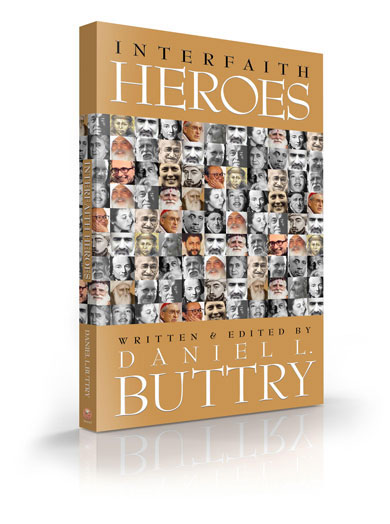
    We want to help. The book we recommend, "Interfaith Heroes" by the Rev. Daniel Buttry, is filled with stories of people who made spiritual connections in pursuit of peace — and includes expert tips on forming interfaith relationships.
    We're also suggesting this easy idea of keeping an "Interfaith Passport."
    Most big cities and university towns now have regular interfaith programs. Often, these are events planned to showcase an array of religious expressions in a single program. But, you also can become a respectful visitor at individual religious events of your own choosing.
    The SECOND most common request we get is to tell our readers about upcoming events. So, on this page devoted to Interfaith Heroes — a page that springs to life each January with inspiring daily stories about those heroes — we're opening up an ongoing calendar for such events. (Naturally, because our Home Office is in Michigan, our calendar may be Michigan heavy, but we welcome events anywhere in the world.)
   There are many other places to look for events, of course! Your newspaper's religion calendar. Or regional interfaith Web sites. Our calendar is just one more opportunity to find events.
   We are NOT co-sponsoring every event we list. We are NOT guaranteeing the quality of every program — but we are trying to help you find fresh ideas for your "pilgrim's progress."

HOW TO USE
THE PASSPORT

We have printed copies of the Passport on 5.5-inch by 8.5-inch card stock with glossy, full color on one side and matte printing on the other. When we fold the Passports in half, they're beautiful pocket-sized keepsakes. At home, you can tuck them into a mirror over your dresser.
   It's your reminder to be an interfaith pilgrim.
   Most home computers are equipped to produce greeting cards and photos — so this should be an easy process to produce a passport for yourself, or even a handful for your friends. Here are links to download the two images. (Right-click on each link and choose "Save Link" to download these high-resolution "jpg" files.):

Download Image of Passport (Front Cover)

Download Image of Passport (Inside Pages)

   If you would like copies in significant quantities, drop us an Email and we're happy to discuss bulk printing of Passports on the high-quality card stock we've used.

COVER OF THE PASSPORT LOOKS LIKE THIS:

Full_front_cover_looks_like_this_2

The cover (unfolded here) has the visual theme of a passport — accented with tiny images of interfaith heroes.

INSIDE OF THE PASSPORT LOOKS LIKE THIS:

Interior_of_interfaith_passport_2

These two pages will get you started with notations on more than a half dozen visits in your pilgrimage.

AN INDIVIDUAL ENTRY LOOKS LIKE THIS:

One_entry_in_interfaith_passport

WE SUGGEST that you make notes on the lines to remember your visit. In the sample below, we didn't specify the location but you might want to do that. Perhaps note who accompanied you on your visit — or who you met there. You might note how the visit affected you spiritually.
    In some parts of the country, religious leaders may wish to develop passport "stamps" for events that they will provide when you attend. But it's easy -- and fun — to make your own. You might save a piece of a ticket stub. I cut this image out of a brochure from a temple that I visited.

Filled_out_entry_in_passport

PLEASE, tell us how you're using these ideas.
    Give us your suggestions.
    Send us items for the calendar — there's an easy link to do that in the middle of this page.
    Mark your calendars to celebrate Interfaith Heroes Month with us in January — when this site will be bursting with fresh stories about heroes.

HOW CAN I NOMINATE AN INTERFAITH HERO?

CLICK HERE and fill out our form.

To give you an idea of what's coming, here are a few samples (below) of Interfaith Hero profiles from our last Interfaith Heroes Month.

January 31, 2008

Day 31: Cardinal Aaron Jean-Marie Lustiger (1926-2007)

31lustiger1edit    Aaron Lustiger was born in Paris in 1926 to Jewish parents who had emigrated from Poland. When World War II broke out, the family fled to Orléans. After reading the Christian Bible, the teenage Lustiger felt drawn to the Orléans Cathedral. He decided to convert to Catholicism, with the reluctant consent of his parents, adding Jean-Marie to his baptismal name.
   Lustiger’s mother Giselle returned to Paris to run the family shop. She was swept up in the Nazi arrests of Parisian Jews in 1942. Giselle Lustiger died in Auschwitz in 1943. Meanwhile Jean-Marie studied while hiding at seminary. He later rejoined his father and sister hiding in the south of France until the end of the war.
   Lustiger became a priest after the war, which caused a complete rift with his father. He was ordained in 1954 and served as a chaplain to the Sorbonne and then as general chaplain to the universities of Paris. In 1969 he became a parish priest, achieving wide recognition as a preacher who spoke with sincerity, humor and a sharp intellect. He was appointed Bishop of Orléans and then Archbishop of Paris. In 1983 Pope John Paul II elevated him to the College of Cardinals. Generally considered a conservative—he called himself a “Modern Traditionalist”—Cardinal Lustiger maintained positive relationships even with people with whom he disagreed politically.
   Criticism of his identity and his calling came from all directions. Some Jews, including the Chief (Azhkenazi) Rabbi in Israel accused him of betraying his people and religion by becoming a Christian, but French Jews defended him. Meanwhile, some French Catholics complained of his appointment because he was “not truly French,” even though he was born in Paris.
   Anti-Semitism and racism have been frequently and violently expressed in French society, and Cardinal Lustiger was a strong verbal opponent of such views. He spoke against xenophobic politicians, holding that all people are equal in dignity because all are created in God’s image. He supported the rights of immigrant workers.
   Twice he attended commemorations at Auschwitz. At a mass in Lodz, Poland, for 200,000 Jews deported to the death camps he said, “The strength of evil can only be answered with an even greater strength of love.” During a time of increasing anti-Semitism, Lustiger participated in France’s Day of Remembrance of the deported and murdered Jews. As he joined in the reading of the names of the dead, he came to Giselle Lustiger and tearfully said, “My mama.” The impact of his public witness was electric.
In 2003 when the wearing of Muslim head scarves prompted an attempt to disallow religious symbols in student’s clothing, Lustinger urged the government to allow such symbols so as not to “disturb a fragile balance” between the state and religion.
    Cardinal Lustiger was proud of being Jewish. He spoke Yiddish and entered the synagogue to recite Kaddish, the Jewish mourners’ prayer, for his mother. He felt his role as a Christian priest was rooted in the Jewish vision of Israel being a light to the nations. He stimulated a French Catholic statement of repentance for the passivity of the Church during the Holocaust and collaborationist participation in the Vichy regime. He encouraged the development of deeper Jewish-Christian dialogue and was given an award for advancing Christian-Jewish relations by the Center for Christian-Jewish Understanding.
When he died in 2007 his funeral at Notre Dame Cathedral began with his cousin chanting Kaddish.

January 30, 2008

Day 30: Harbhajan Singh Khalsa Yogiji (1929-2004)

30singhkhalsaedit    Harbhajan Singh Puri was born in 1929 in the part of India that is today Pakistan and was still a teenager when he was called initially to serve as a heroic leader to his own people.
   In 1947 during the violence associated with the partition of Pakistan from India, he was only 18 but managed to lead his village of 7,000 people 325 miles on foot to safety in New Delhi.
   Later, he studied economics and entered government service. During his academic and professional career he taught yoga. In 1968 he left India, first for Canada and then settled in the United States where he became a citizen in 1976. He then changed his name legally to Harbhajan Singh Khalsa Yogiji, known as Yogi Bhajan for short.
   For centuries the followers of the Kundalini Yoga system followed a tradition of keeping their practice shrouded in secrecy. However, Yogi Bhajan broke with that tradition believing that the larger public could benefit from the practices of Kundalini Yoga. He called the life system “3HO” (healthy, happy, holy).
   Under his guidance the 3HO Foundation established more than 300 centers in 35 countries. Besides teaching yoga philosophy and practice, 3HO promoted women’s issues, human rights and education in alternative systems of medicine. He pioneered a drug rehabilitation program that was became highly respected in the U.S.
   He also used his professional background in economics and his entrepreneurial skills to expand the health food business. Among the products he promoted was a breakfast food called Peace Cereal. He used these innovations to promote socially responsible business practices, such as a move toward using organic foods.
   Yogi Bhajan was a strong advocate for world peace and religious unity. He met with religious leaders of all faiths, including the Dalai Lama, Pope Paul VI, Pope John Paul II and two Archbishops of Canterbury. He was a regular participant in interfaith activities such as the Parliament of the World’s Religions and the World Fellowship of Religions, serving as co-president of the latter. He was an organizer of the “Meeting of the Ways” in San Francisco and was a co-founder of the Unity of Man Conference. The Peace Abby in Sherborn, Massachusetts, gave him their “Courage of Conscience Award” for his work on interfaith relationships and world peace.
   In 1985 he established the first International Peace Prayer Day Celebration. The annual day of musical celebration and interfaith prayer has drawn many national and international leaders. Yogi Bhajan favorite saying was, “If you can’t see God in all, you can’t see God at all.”

January 23, 2008

Day 23: Abraham Joshua Heschel (1907-1972)

23heschel3edit    Abraham Joshua Heschel was born in 1907 in Warsaw, Poland, a descendent of eminent rabbis on both his parents’ sides of the family. He studied in Germany under some of the great rabbinical minds of the age and became a rabbi himself. As the Nazis came to power Heschel escaped first to England and then to the United States. He eventually became a professor at the Jewish Theological Seminary of America, the main seminary for Conservative Judaism.
   Heschel sought to balance a serious concern for Jewish law as a traditional part of everyday Jewish life with a deeper love for the spirit of the law. He explored that delicate but important balance between faithful observance and legalism.
   He especially studied the prophets and applied their teachings to the issues of social justice in the United States. At that time most Jewish theologians in the world of academia never ventured far from their classrooms. Few academics dove into the rising struggles over justice and civil rights.
   Heschel blazed a courageous path. He taught that the prophetic tradition required him to engage in the U.S. civil rights movement as well as the struggle for freedom for Jews in the Soviet Union.
   Through his involvement in social issues Heschel developed relationships with Christian leaders such as the Rev. Dr. Martin Luther King, Jr. He marched alongside Dr. King in Selma, Alabama, saying, “When I march in Selma, my feet are praying.” He saw religious passions and commitments as a fundamental part of a healthy, faithful human life. No religion could claim all the truth, he said, since God transcended any particular theology, so religious communities need to be engaged with each other for the sake of their common humanity.
   He raised these provocative and inspiring teachings, even though Heschel remained deeply committed to his Jewishness. In fact, he was almost Orthodox in his practice.
   Throughout his life, he was committed to relationships with people in other faiths. Heschel was chosen to represent American Jews for constructive dialogue with the leadership of the Roman Catholic Church during the Second Vatican Council in the 1960s, resulting in historic shifts in Catholic policy and liturgy that had been demeaning to Jews. His willingness to enter into these interfaith relationships also led to his appointment as the first Jew on the faculty of Union Theological Seminary, the premier Protestant seminary in the U.S.
   Heschel was one of the founders of Clergy and Laity Concerned about Vietnam. He became co-chair of this inter-religious organization that sought to end that war, seeing what was happening as a challenge to the very soul of America. In his frequent comment, “Some are guilty, but all are responsible,” he put forth the challenge to engage in the pressing issues of the day as a person of faith.

January 19, 2008

Day 19: Howard Thurman (1900-1981)

19howardthurmanedit_2    Howard Thurman was an author, philosopher, theologian, pastor, educator and civil rights leader. The grandson of a slave, he graduated from Morehouse College as valedictorian in 1923. Shortly thereafter he was ordained as a Baptist minister, but his studies with the Quaker mystic Rufus Jones introduced him to a broader range of spirituality. Thurman became the Dean of Rankin Chapel at Howard University.
   While leading a student “Pilgrimage of Friendship” trip to India, Thurman and his wife, the former Sue Bailey, had a meeting with Mahatma Gandhi that gave focus to a growing passion in his ministry. He envisioned an interracial church in the days when most blacks were excluded from white churches. When Thurman asked, “What is the greatest enemy that Jesus Christ has in India?” Gandhi responded, “Christianity.” Thurman resolved to remain within his Christian tradition but work at overcoming the divisive influences within race and religion that split so much of society.
   By 1944, Thurman had joined with a small interracial circle of friends, initially Quakers and Episcopalians, to found a neighborhood church in San Francisco called The Church for the Fellowship of All People, the first intentionally interfaith congregation in the United States. Thurman was chosen as founding co-pastor along with Dr. Alfred Fisk. They sought to preach truths that would be embraced by all people of faith and offer expressions of spirituality from many global cultures and religions. Jews, Buddhists and Hindus joined in the church as well as people who were alienated from all organized religion. Thurman’s basic theme was, “We are one at any level.”
   Speaking of his work in promoting inter-religious fellowship, Thurman said: “Man builds his little shelter, he raises his little wall, builds his little altar, worships his little God, organized the resources of his little life to defend his little barrier, and he can’t do it! What we are committed to here, and what many other people in other places are committed to, is very simple – that it is possible to develop a religious fellowship that is creative in character and so convincing in quality that it inspires the mind to multiply experiences of unity – which experiences of unity become over and over and over again more compelling than the concepts, the ways of life, the seeds and the creeds that separate men. We believe that in the presence of God with His dream of order there is neither male nor female, white nor black, Gentile nor Jew, Protestant nor Catholic, Hindu, Buddhist, nor Moslem, but a human spirit stripped to the literal substance of itself.”
   In 1954 Thurman left to become the first black Dean of Marsh Chapel at Boston University. He was an active voice in the civil rights movement, exerting a major influence on the spirituality of the young Martin Luther King, Jr. Following his death in 1981, Howard Thurman’s writings continue to speak about spirituality and justice, influencing the vision and work of new generations.

January 17, 2008

Day 17: Martin Buber (1878-1965)

17martinbuber1    Martin Buber was a Jewish philosopher and theologian who had a profound impact on both Jewish and Christian thinking. He embodied the ideal of dialogue and understanding between people of different faiths and even conflicting interests. He felt that faith could play a positive role in creating a more humane world.
   He was born in Vienna, Austria in 1878. As a student, Buber strayed from his religious roots, but the anti-Semitism in Europe prompted him to join the early Zionist movement. As he went through a religious reawakening, he extensively studied Hasidism, the Jewish renewal movement. Though he never became Hasidic, he embraced their call to holiness in everyday life. He called for people to affirm the world for God’s sake so that we could transform it.
   As professor of Jewish religious history at the University of Frankfurt, Buber published his classic book, I and Thou, about the relational nature of human existence. He held that the quality of our relationships should be the basic measure of the quality of our humanity.
When the Nazis came to power, Buber was promptly dismissed from his academic position and he began to campaign for Jewish rights against the rising tide of fascism. By 1938, he was so restricted by the Nazis that he decided to escape from Germany to Jerusalem where he became a professor at Hebrew University.
   Buber retained his Zionism, but he felt that nationalist expressions were headed in the wrong direction. He called for a “Hebrew Humanism” in which Jews and Palestinian Arabs could find a just and cooperative arrangement to deal with issues of the land. The outbreak of war in 1948 left him deeply saddened, but still committed to building human relationships.
   Buber had a major impact on Christian thinking through his popularization of Jewish spirituality and mysticism. He recognized the Jewishness of Jesus and saw him as an example of some of the highest ideals in Judaism. However, he saw that there were many irreconcilable differences between the two faiths, yet these differences should not stop dialogue.
   He wrote, “Whenever we both, Christian and Jew, care more for God Himself than for our images of God, we are united in the feeling that our Father’s house is differently constructed than our human models take it to be.” Martin Buber died in Jerusalem in 1965.

January 15, 2008

Day 15: Etty Hillesum (1914-1943)

15ettyhillesum1    Etty Hillesum was a young Jewish woman from Amsterdam who was swept up by the Nazi occupation and Holocaust. She died in Auschwitz on November 30, 1943, at the age of twenty-nine, but she is known for the vitality of her witness for life and love amid the horrors of hatred and destruction.
   For the last two years of her life, she kept a diary that was discovered and published forty years after her death. Now, the lives of people from many faiths have been shaped by Hillesum’s deep spirituality. In her diary, she expressed her mystical relationship with God that enabled her to live fully and with moral clarity in the face of great suffering.
   She worked as a typist for the Jewish Council in Amsterdam, a privilege that kept her from being deported for awhile. But then she volunteered to accompany her fellow Jews to the camps, feeling a spiritual calling to be present at the heart of the suffering, to “become the thinking heart of the concentration camp.” She believed the effort to preserve in one’s heart the spirit of love and forgiveness was the greatest task one could take up. She did not glorify suffering as such, but she desired to redeem the experiences of suffering by finding God deep within. Even in the concentration camps with death ever present she envisioned the way she lived her life as a way to prepare for a new age whether or not she would survive to see it.
   Though clearly rooted in her Jewish faith and scriptures, she drew upon a wide range of writers for her own reflection and spiritual development, including Rilke, Augustine, and Dostoevsky. When criticized for talking about love of enemies and sounding too much like she was expressing Christianity, she responded, “Yes, Christianity, why ever not?”
   She did not participate in organized religion, but she held strongly to a personal encounter with God that could be discovered both at the depths of one’s own being and in other people as well.

January 14, 2008

Day 14: Muriel Lester (1885-1968)

14muriellester2    Muriel Lester was born into a wealthy Baptist family in England in the late-1800s. Early in her life she showed a non-conformist radicalism in her faith, especially over concerns for social justice. While traveling by train through the slums of London she began to see poverty as a moral challenge. She committed herself to voluntary poverty, moved into the Bow neighborhood of London and began to help poor families as a social worker. She purchased an old church building and turned it into Kingsley Hall, a social service center. Lester mobilized people in the community to determine together what issues to address and how to deal with them. She was able to empower people, especially those who thought they had no power.
   During World War I, Lester became a pacifist and joined the newly formed International Fellowship of Reconciliation (IFOR). Her post-war efforts at famine relief launched the movement that became the Save the Children Fund. Through her IFOR connections, she invited the son-in-law of Rabindranath Tagore, the great Hindu poet and philosopher, to speak at Kingsley Hall. In turn, he invited Lester to India.
   On that visit, she developed a life-long friendship with Gandhi. Gandhi challenged her, “Speak the truth, without fear or exaggeration, and see everyone whose work is relative to your purpose. You are on God’s work, so you need not fear men’s scorn.” When Gandhi came to Britain in 1931 he stayed at Kingsley Hall for three months. As a Christian and as a Hindu, Lester and Gandhi took the teachings of Jesus and applied them to the struggles for freedom from colonial power in India.
   In 1933 Lester turned the leadership of Kingsley Hall over to her sister. Lester then became the traveling secretary for IFOR. She conducted prayer schools around the world with people of many different religions: Muslims, Jews and Hindus. Wherever she found violence and injustice, she worked to mobilize people of faith to struggle against those problems.
   Muriel Lester lived the message of reconciliation in every sphere of human life, including religious reconciliation. In her own words, she sought to share “the vision of God as Love and Beauty, and the sense of comradeship which brings strength and vigour to the weakest.”

January 12, 2008

Day 12: Mohandas “Mahatma” Gandhi (1869-1948)

12ghandi2    Mohandas K. Gandhi led the movement in India for independence from British colonial rule. His approach to nonviolence was called satyagraha, with literally means “truth—hold on” and has been popularized as “truth force.” He initially developed his nonviolent philosophy and practice during the twenty years he lived in South Africa. Trained as a lawyer, he led Indians in South Africa in protests against the racist policies of the white government, culminating in 1914 with some concessions, granting new rights for the Indian immigrant community.
   Returning to India, Gandhi, now given the honorific title “Mahatma,” threw himself into the struggle against British colonialism. He organized campaigns of non-cooperation with British political and economic power, highlighted by his “Salt March” across India to the sea where he made salt in defiance of the British monopoly on this vital commodity. Eventually, through a long, complex struggle India achieved independence in 1947.
   Gandhi also struggled for justice within Hindu society, especially calling for raising the status of the “untouchables.” Though he was from an upper caste, he advocated an end to the social and economic injustices in the caste system. His conviction on this matter was so intense that he launched a “fast to the death” from prison in one campaign that successfully eased a particular restriction.
   Gandhi was a devout Hindu, but he drew much of his inspiration from the teaching of Jesus and the Russian Christian pacifist Leo Tolstoy. Many Christian friends lived in his ashram and joined him in his actions. Gandhi often quoted the Christian scriptures and said to his Christian friends, “to be a good Hindu also meant that I would be a good Christian. There was no need for me to join your creed to be a believer in the beauty of the teachings of Jesus or try to follow His example.” The three books he carried with him everywhere were the Bhagavad Gita, the Bible and the Quran.
   Gandhi also bridged the two largest religious groups in India: Hindus and Muslims. He worked closely with Abdul Ghaffar Khan, a Muslim friend and nonviolent activist for independence. They each took the principles of their own faiths and applied them to the same nonviolent practices in the same struggle for freedom.
   When violent riots erupted in India between Hindus and Muslims, Gandhi pleaded for peace. To underscore his message, he began long fasts directed to his own Hindu community, calling upon them to halt the violence. Following the successful end of inter-communal violence in Calcutta in response to his fast, Gandhi was assassinated in 1948 by a Hindu extremist.

January 10, 2008

Day 11: Henrietta Szold (1860-1945)

11henriettaszold2    Henrietta Szold was born in 1860, one of eight daughters of a Baltimore rabbi and his wife. She became a passionate student of Judaism, and was even allowed to study at the Jewish Theological Seminary, only open to men at that time. She became an early Jewish voice for women’s rights.
Szold founded Hadassah Women, the largest Jewish organization in the U.S. As a Zionist organization Hadassah was involved in the 1930s in saving Jewish youth from Germany and then later from across Europe. About 22,000 Jewish children and youth were rescued from the Nazis through Hadassah’s work, a legacy built upon the foundation of Szold’s advocacy and activism.
   From Hadassah’s inception, Szold opposed discrimination and she voiced this important value in a prophetic way. This became a complex issue as Hadassah began to engage in healthcare in Palestine.
During and following World War I, American Jews organized the American Zionist Medical Unit to deal with some of the suffering of Jews in Palestine. The huge problems and organizational chaos led Szold to come to Palestine in 1920 to take over the organization. She established the Hadassah Medical Organization to care for women and children. She insisted that the organization work with Arabs, Muslim and Christian, as well as Jews, providing the same care to all people with the best medical technology possible.
   Following her model, the organization served people of all origins and religions equally and cooperatively. The Hadassah Hospital in Jerusalem, which grew out of the original organization that Szold headed, is now the premier medical institution in Israel and the entire Middle East.
Szold envisioned nondiscriminatory health care as providing a bond between Jews and Arabs for building common community – but this has not been easy amid the volatile politics and frequent violence in the region. In 1948, before the state of Israel was established, 77 Jewish doctors and nurses from the hospital were killed by Arab soldiers.
   Nevertheless, Hadassah has continued to practice cooperation, coexistence and nondiscrimination even as Hadassah treats more victims of on-going violence than any other medical center. Szold’s work has continued beyond her death through the staff of Hadassah, resulting in a nomination of the Hadassah Medical Organization for the Nobel Peace Prize in 2005.
   Through the most difficult times, the cooperative context of Hadassah’s healthcare has provided opportunities for creating bridges of communication and initiatives for peace.

Day 10: Rabindranath Tagore (1861-1941)

10tagoreedit    Rabindranath Tagore was a literary giant in India. Born into a Bengali Brahmin family in Calcutta, Tagore founded an ashram in West Bengal that included an experimental school. He believed that God was found through personal purity and service to others. Tagore was known primarily for his poetry which was deeply influenced by the mysticism of the Hindu Upanishads but at the same time was accessible to many Western readers. In 1913 he was awarded the Nobel Prize for Literature becoming Asia’s first Nobel laureate.
   However, Tagore was prolific in many other artistic fields. Besides his poetry, Tagore produced many novels, short stories and dramas. He wrote non-fiction works on diverse topics: Indian history, linguistics, travelogues and science. He composed more than 2,000 songs, including many devotional hymns and the national anthems for both India and Bangladesh. When he was sixty he began to draw and paint, and his art was exhibited in Paris and London.
   Tagore was a controversial figure in Indian politics. He supported the Indian independence movement and was a friend of Gandhi, but he also disagreed with Gandhi over many issues. He was especially virulent in his attacks on nationalism. He denounced fascists, Japanese and American nationalists, and even the nationalism in the Indian independence movement.
   He spoke out against India’s “abnormal caste consciousness,” decrying the evils of social systems in India that left millions in poverty and labeled entire groups of people as “untouchable.” He raised feminist concerns in his writings, calling for liberation of women from many of the customs in marriage. In his stories, he attacked those who still glorified the custom of self-immolation by women after their husbands’ deaths.
   Tagore’s writings were influenced by many religious streams. The Muslim mystical poet Hafez was an inspiration to him. He used a Buddhist story of Ananda, one of Gautama Buddha’s disciples, who asked an untouchable girl for water, as an exemplary tale for his Hindu culture. During Tagore’s travels he engaged with many people in discussions of a transcendent humanism. He addressed the annual Quaker gathering in London, and became a friend and associate of Charles Andrews, the Christian missionary who was Gandhi’s protégé. Tagore was deeply disturbed by the tensions and violence between the Hindu and Muslim communities in India. He explored these issues in his writings, taking on the religious zeal that leads to bigotry and violence, especially when wedded to nationalism.

January 09, 2008

Day 9: Sarah and Angelina Grimké (1792-1873 and 1805-1879)

09angelinagrimkeedit    Sarah and Angelina Grimké were sisters born on a plantation in South Carolina. These belles of the South blazed a trail not only for abolitionists but for women’s rights, and in so doing they blazed a trail for interfaith tolerance as well.
   Sarah observed from an early age that slavery was a reprehensible institution, degrading slave and slave owner alike. She argued that slavery was not “Christian” and that slaves should be educated and freed. She traveled to Philadelphia where she met Quakers who encouraged her anti-slavery stance. When she returned to Charleston she began to speak out against slavery.
   Her forceful abolitionist views were unacceptable to her home Episcopal Church. She felt drawn to the Society of Friends (Quakers) but discovered that, even to many Quakers, radical abolition was uncomfortable and that public advocacy of a cause by a woman was equally so. During a time when any participation in the religious practices of other faiths was grounds for excommunication, she determined to ally herself with people from other faiths who shared her abolitionist beliefs. Thus, religious toleration became a necessary part of her fight for the abolitionist cause. In her time and social context in the South, religious toleration was an issue concerned more with the diversity of Christian denominations than different religions.
   As a child Angelina found slavery equally reprehensible. She objected to the law that slaves should not be taught to read. She taught her personal slave to read and, when caught, was severely reprimanded. Raised as an Episcopalian, she refused to be confirmed at age 13. Instead she joined the Presbyterian Church and began to take considerable interest in interfaith work. When her former minister tried to get her to renounce her new faith, she responded, “I could not conscientiously belong to any church which exalted itself above all others and excluded ministers of other denominations from its pulpit. … I have lately succeeded in establishing a female prayer meeting among Baptists, Methodists, Congregationalists and Presbyterians.”
   When even the supposedly liberal Presbyterian Church did not support her abolitionist beliefs, Angelina left the South and joined her older sister Sarah in Philadelphia. The Grimké sisters became celebrated agents of the abolitionist movement and were in high demand as public speakers. Their activism led to being banned from the Society of Friends, but they continued to press for complete abolition along with others from many faiths who shared their convictions.
   They were among the first to make the argument that women’s subjugation was tantamount to slavery in many ways. In 1838 in Boston, Massachusetts, Angelina Emily Grimké was the first woman to address an American legislature. Despite receiving many death threats they continued, at great risk to themselves, to advance the causes of interfaith tolerance, women’s rights and abolition of slavery.

January 07, 2008

Day 7: Moses Mendelssohn (1729-1786)

07mosesmendelssohn1edit    Moses Mendelssohn was an 18th-Century German-Jewish philosopher.
   He was such a giant in the intellectual growth of European Jewish culture that some call him the third Moses (after Moses from the Bible and Moses Maimonides). Mendelssohn began his work in the fields of metaphysical philosophy and mathematics, engaging all the top scholars of his day with his elegant and lucid style of writing. He was hailed as a German Socrates.
   Earlier in his academic career, Mendelssohn had been focused primarily on philosophy. A turning point in his intellectual passion came when Johann Lavater, a Christian admirer, challenged him to a debate, hoping to convert the Jewish philosopher. This exchange prompted Mendelssohn to delve deeper into his own Judaism. He translated the Pentateuch into German and wrote a commentary on Exodus. He also expanded beyond solely academic pursuits into ways that he could help emancipate Jews in Europe intellectually and legally.
   His later writings dealt with the issues of religious emancipation and the relationship of church and state. In his book, Jerusalem, he held that the state has no right to interfere with the religion of its citizens, a call to reform that the philosopher Immanuel Kant found irrefutable.
In diverse societies he suggested the pragmatic principle of the possible plurality of truths. He argued that there may need to be different religions to deal with the diversity of humanity, and each one should be respected. For Mendelssohn, the true test of religion should be how it positively affects our human conduct.
   Mendelssohn’s own conduct was so noble and persuasive that the Christian philosopher and writer Gotthold Ephraim Lessing used him as the model for the title character in the 1779 play Nathan the Wise, which was an appeal for religious tolerance.
   Mendelssohn also spoke out against the use of excommunication as a religious threat to people speaking their conscience. He personally worked on improving the relations between Jews and Christians, urging tolerance and a shared commitment to our common humanity.

Ongoing Interfaith Exhibits and Events

  • "Gather up the Fragments: The Andrews Shaker Collection"

    A rare chance to learn more about the Andrews family that pioneered in the preservation of Shaker culture and historical sites. The story of Faith and Edward Deming Andrews is one of spiritual exploration, passion, intrigue and scholarship.
    Until October 31, this exhibition is at Hancock Shaker Village, 1843 W. Housatonic Street, Pittsfield, MA 01201
    Web site: http://www.hancockshakervillage.org/

Blog powered by TypePad

Participate

We'd like to hear your feedback about this site or this project at InterfaithHeroes@gmail.com

Buy the Book

  • Interfaith Heroes Book

Speak out

  • from George Polley

    Wonderful! I like people like this, and have a number of them on my list of spiritual heroes. Here are two of mine: Archbishop Desmond Tutu of South Africa and Dom Helder Camara of Brazil.

  • from David Crumm

    WELCOME!
    .
    We've redesigned this Web page to help people explore the broader world of interfaith diversity. We've added a calendar -- just a sampling of events in various regions where you'll encounter religious and cultural diversity.
    .
    AND -- we encourage you to try our new Interfaith Passport idea (details at left).
    .
    Tell us what you think! Add your own comment.

  • from Arminader Kaur

    Harbhjan Singh Khalsa Yogiji, or Yogi Bhajan, is known throughout the Sikh community for his work within his community and for outside communities as well. He began his yogic training when he was eight years old. During the partition in 1947, the 18-year-old led his village consisting of 7000 people out of what is Pakistan today and into New Dehli. Then in 1968 he went to Canada to teach yoga. During a visit to Los Angeles he met hippies and helped them find the peace they found in drugs in the Science of Kudnalini Yoga, therefore finding an alternative to the drug culture of that time. He played a very significant role in motivating and inspiring people in the Sikh way of life. In 1971, because of his efforts to spread the universal message of the Sikhism, the Sikh faith was legally recognized as a religion in the USA. He taught Kundalini Yoga publicly and created the “3HO” (healthy, happy, holy) way of life. Due to its popularity, the 3HO became a NGO (non-governmental-organization) in the United Nations in 1994. Yogiji met with leaders from all faiths like Pope Paul VI, Pope John Paul II, the Dalai Lama, and two Archbishops of Canterbury. He lived out his message by creating an awareness for the importance of world peace and unity. For this, he was awarded the Conscience Award from the Peace Abbey in Sherborn, Massachusetts in 1995. He was an active participant in interfaith conferences and he attend the World Parliament of Religions and in 1985 he established the first International Peace Prayer Day Celebration in New Mexico. He passed on Oct. 6, 2004 from heart problems and is remembered y Sikhs and Non-SIkhs throughout the nation.

  • from Barbar Talley

    As I reflect on the 1940’s era in the United States, my mind goes back to a time when the country was deeply separated by racism, and a time of World War II when men and women went to war and returned to a segregated society. Certainly it was a time when the religious segment of society was separated by color, religion and faith. I marvel how an African American, Howard Thurman, could have such a deep religious foresight, vision and wisdom to ignore the racial and religious barriers so prevalent during the 1940’s, to help found the first intentionally interfaith congregation in the United States with Quakers and Episcopalians? How strong and deep were the faiths of those founding members. Howard Thurman was certainly a trailblazer in the area of interfaith relations. No doubt Howard Thurman’s studies at various distinguished colleges, universities and seminaries exposed him to teachings, readings and contacts that gave him a broader and deeper spiritual substance to know and understand that God makes no separation of race, color, gender, or religious faiths. He had a deep understanding that the soul and spirit of mankind have no barriers or boundaries. My research for an African American to be included in the Interfaith Heroes booklet led me to learn about Howard Thurman through Rev. Dr. Carlyle Fielding Stewart, III, senior pastor of Hope United Methodist Church, Southfield, Michigan. Rev. Stewart immediately gave me Howard Thurman’s name because of his renowned reputation in the religious field. Dr Martin Luther King, Jr. was a recipient of Howard Thurman’s teachings and beliefs. They both were influenced by Mahatma Gandhi’s philosophy of brotherhood amongst differing religions and ethnicities, that “Truth is God,” and at the core of every religion was truth and love. Howard Thurman shed a deeper light on our inner self and challenges us to look at others as a creation of God made in His image “imago dei”. Our interactions and relationship with others gives us an opportunity to please God, who loves us all. Love is the central attribute of God and therefore must be the central characteristic of His people. How then can we separate the love of God and humankind by religious faiths? Today it is more crucial than ever to move to a broader level of interfaith relations. We have entered in a world where human community and cooperation are essential because of the rapid growing political, economic, scientific, ecological and sociological globalization where there is a need to cross boundaries. There must be the ever presence of the family of religions for stability and inclusion of altruistic values. The religious diversity in the world challenges us to work toward a common bond. We can all take up the challenge began by Howard Thurman.

  • from Paul Chaffee

    It is deeply gratifying to see you identify Howard Thurman as an interfaith hero. Even better was reading your essay and seeing how well you've condensed his story. As one who studied Dr. Thurman's work seriously and enjoyed an informal mentoring relationship for several years, I think your essay drives to the heart of his remarkable vision.

    In the seventies, when I was in seminary, Dr. Thurman was treated somewhat dismissively as a 'devotionalist.' Taking a year-long seminar in Whitehead's process thinking and finding the same philosophical assumptions undergirding Thurman's thinking, suggested that the academics would catch up one day. Which they have, thank goodness.

    Waking up in a new religious world, where interfaith relationships have gone from overseas to across the street, we badly need his wisdom.

    Thurman's books and dozens of available audio tapes available can sweep you away with their heart energy. Getting better acquainted, you discover the elements for an interfaith frame-of-reference providing us with tools to affirm our own faith and practice with integrity, without making others "wrong." Embodying that wisdom in the world is the great task of anyone hoping for a vital, healthy interfaith future on Earth. Thurman's work is an asset on the way.

    Speaking as an interfaith Christian, I don't know of any text more likely to enlarge the size and scope of a person's understanding of Jesus Christ than Thurman's "Jesus and the Disinherited" (1949). It brilliantly undercuts the notion that any one vision of Jesus has a corner on understanding and relating to the man.

    The Thurman essay is the first I've read in this series. Thank you! whoever you are, for creating this site!

  • from Bob Bruttell of Interfaith Partners

    Greg Peterson comments that many of the interfaith heroes we present in this book have been dead for a while now. Partly that is because the daily presentations are organized chronologically from earliest to latest. By the end of January you will find that several only died in the last 15 years and several of those just recently. Also we tried to find interfaith heroes throughout history so we were not focusing on the recent past alone. Another of our criteria was that these heroes were all to be among our deceased forebears because too much controversy swirls around heroes who are still alive. That controversy might diminish the work we are trying to do.

    Are there heroes today? Certainly. But as you might suspect they are few because breaking down religious and ethnic barriers is difficult and sometimes dangerous. Nevertheless, there are heroes who are our contemporaries. I think we all know some of them. I can think of the work of Senator George Mitchell in Ireland. Hans Kung also comes to mind. How about Eleanor Josaitas at Focus: HOPE who I know would be humbled to be mentioned in the same sentence with Mother Theresa as I am doing here. Possibly the Dalai Lama, Nelson Mandella and Archbishop Desmond Tutu should be on this list. As you can see my experience brings to my mind mostly Christians but I know that there are Muslims and Hindus and Sikhs and others that are breaking down religious barriers today. I hope Greg and other visitors to this site will suggest more candidates to us.

    Finally, I think we may have to be the heroes we are waiting for because our time needs interfaith heroes as much as any other.

  • from Greg Peterson

    I noticed that all these wonderful people have been dead for at least a quarter century (most much longer).
    Is there a modern-day person (or someone who has recently passed) who has accomplished peace on the level of any of these people.
    And if not - why do you think that is?

  • from Anneliese Sinnott

    The last 20 years of my life have been immersed in the “ecumenical reality” of the Christian Church. As a Roman Catholic, ecumenism has only been on my “radar screen” since the time of the Second Vatican Council. Muriel Lester, however, recognized the value of ecumenical work more than one hundred years ago. In all of the efforts that she made to organize and galvanize people to challenge poverty and the lack of human rights that characterized the lives of so many in her early 20th century English environment, she had a broad vision. Lester seems to have realized early on that the hard work of confronting “less-than-equal” prospects for living out one’s life could not be done alone. She gives strong evidence of a passion that working together, as believers, convinced of a divine call to wholeness for everyone, is the only way to change the world.

    The movements founded by Lester, in particular the International Fellowship of Reconciliation, have endured for almost a century. This fact verifies the strength of her approach: wholeness in life will be available only if peace becomes the ground on which it is built. Lester’s life calls me, calls all of us, I believe, to examine our lives and our society carefully, and resist all the subtle ways in which we daily participate in some form of violence. Becoming a person of peace is a serious challenge, one to which lives such as that of Muriel Lester calls us daily.

  • from Imam Steve Mustapha Elturk

    There are four things that describe the success of Gandhi as a social reformer. One: believing in his "Free India" mission. Two: being faithful and sincere to his cause. Three: the level of sacrifice throughout his struggle. And four: endurance and perseverance that eventually lead him to victory. Gandhi was a remarkable individual.

    The fundamental moral principle known as the golden rule, "treat others as you would be treated" was one of Gandhi's most substantial traits. His philosophy on "All Men are Brothers" earned him respect from among all the classes of his nation. He was once asked, are you a Hindu? Gandhi replied: "Yes I am. I am also a Christian, a Muslim, a Buddhist, and a Jew." Gandhi understood the importance of working with all people of different religions and cultures for the common good of the people and nation. His simple life style and love for the poor earned him great respect from among the less fortunate of his nation. His witty remarks earned him trust from the elite of his society. He was accepted by all.

    Gandhi's non-violence, non-cooperation, and peaceful resistance were the only weapons he used in the face of oppression and injustice. His philosophy of non-violence has influenced many non-violent movements since. Dr. Martin Luther King in the civil rights movement established his own strategies on the basis of Gandhi's non-violence method. Others, such as the anti-apartheid activist and former president of South Africa, Nelson Mandela, were inspired by Gandhi.

    Gandhi wanted freedom for his nation and he got it. He was an amazing personality. On June 15, 2007, it was announced that the United Nations General Assembly unanimously adopted a resolution declaring Gandhi’s birthday, October 2, as "The International Day of Non-violence."


  • from Gail Katz

    Henrietta Szold is a true interfaith heroine. She insisted that Hadassah Medical Organization work with Arabs, Muslims and Christians, as well as Jews, in order to provide the same care to people of all faiths that lived in Palestine during her lifetime. Her dream lives on today, as Hadassah Hospital, the premier medical institution in Israel, continues to care for people of all religions equally.

    As the daughter of a rabbi and a woman steeped in her Judaism, Henrietta Szold knew the true meaning of the commandment to perform “tzedaka”, which is literally translated as “justice” or “righteousness.” As a Jew, Henrietta didn’t really have a choice to stand or not stand by her fellow man. She was obligated to perform acts of social justice, one of the 613 commandments in the Torah. Henrietta obeyed this commandment by dedicating herself to the humanitarian work of providing healthcare and education to all faith communities living in Palestine, in addition to rescuing Jewish children from Nazi Germany and working to maintain a connection between Hadassah in Palestine and its supporters in the United States.

    As president of WISDOM, Women’s Interfaith Solutions for Dialogue and Outreach in MetroDetroit, I can’t help but define Henrietta Szold’s good works as emanating from her womanhood, from her deep passion for wanting a world that is safe for children, a world that works to end violence and restore health. The mission of WISDOM, to establish venues for community service projects to help “repair the world” while establishing the chance to dialogue with people of different faith traditions, seems to parallel Henrietta Szold’s heroic success in the caring for the sick, the poor, and the downtrodden, while furthering an understanding and respect for humanity – no matter what the culture, tradition, language or religion.

    I read recently, in an article by Deborah Weissman (“The Co-existence of Violence and Non-Violence in Judaism” published in the July 2007 issue of Interreligious Insight) about the parable of the chassida, or stork in Hebrew. This bird is called chassida because it does acts of chessed, or loving kindness, in sharing its food with other storks. This bird, however, is not kosher – permissible to be eaten according to the Torah’s dietary laws. A 19th century rabbi stated that the stork was not kosher because it did acts of loving kindness with other storks, only with other storks, and not with any other birds. Dr. Weissman suggests that the stork is a symbol of both the strength and the problems of religious communities. The strength of closely-knit religious communities is that they give support to members of their own group, but do not behave in such humane ways towards outsiders or members of other communities. Dr. Weissman states that the challenge for our religious communities is “to behave towards each other like human beings, not like storks.”

    Henrietta Szold, our interfaith heroine, had the qualities of being a nurturer and caretaker. Although she was an ardent Zionist and supporter of the Jewish people, she made sure that her acts of loving kindness included the interfaith human family living in Palestine during her lifetime.

Published by David Crumm Media, LLC